Free Download Make It Stick: The Science of Successful Learning
When his is the time for you to constantly make handle the feature of guide, you can make bargain that guide is really advised for you to obtain the very best suggestion. This is not just finest concepts to acquire the life however additionally to go through the life. The way of life is sometimes complied with the case of excellences, however it will certainly be such point to do. And also now, guide is once more recommended here to review.
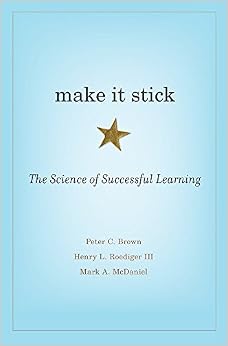
Make It Stick: The Science of Successful Learning

Free Download Make It Stick: The Science of Successful Learning
Introducing a new hobby for other people may inspire them to join with you. Reading, as one of mutual hobby, is considered as the very easy hobby to do. But, many people are not interested in this hobby. Why? Boring is the reason of why. However, this feel actually can deal with the book and time of you reading. Yeah, one that we will refer to break the boredom in reading is choosing Make It Stick: The Science Of Successful Learning as the reading material.
A publication is much pertaining to checking out activities. Reserve will be absolutely nothing when none reads it. Reading will certainly not be completed when guide is just one of the subjects. Nonetheless, in this modern age, the visibility of book is expanding sophisticatedly. Several sources make the both publication in published and also soft data. Having the soft documents of publication will certainly alleviate you making real to review it. It can be saved in your various tool, computer, CD, laptop computer, even the gadget that you constantly bring all over. It is why; we reveal you the soft documents of Make It Stick: The Science Of Successful Learning as one of matter to check out.
Own this book asap after finishing read this internet site web page. By owning this publication, you can have time to spare to review it of course. Even you will not have the ability to finish it in other words time, this is your possibility to alter your life to be much better. So, why don't you spare your time even sticks out couple of in a day? You can review it when you have extra time in your workplace, when remaining in a bus, when being at house prior to sleeping, as well as much more others.
Furthermore, when you have the reading practice, it will certainly lead you to keep and go forward for far better condition. A publication as one of the home windows to reach much better world can be achieved by situating the knowledge. Even you have no concepts regarding guide previously, you could comprehend a growing number of after starting from the very first web page. So, exactly what do you think about Make It Stick: The Science Of Successful Learning that you can take it to check out from now?
Review
“If you want to read a lively and engaging book on the science of learning, this is a must… Make It Stick benefits greatly from its use of stories about people who have achieved mastery of complex knowledge and skills. Over the course of the book, the authors weave together stories from an array of learners―surgeons, pilots, gardeners, and school and university students―to illustrate their arguments about how successful learning takes place… This is a rich and resonant book and a pleasurable read that will leave you pondering the processes through which you, and your students, acquire new knowledge and skills.â€â€•Hazel Christie, Times Higher Education“Many educators are interested in making use of recent findings about the human brain and how we learn… Make It Stick [is] the single best work I have encountered on the subject. Anyone with an interest in teaching or learning will benefit from reading this book, which not only presents thoroughly grounded research but does so in an eminently readable way that is accessible even to students.â€â€•James M. Lang, Chronicle of Higher Education“Aimed primarily at students, parents, and teachers, Make It Stick also offers practical advice for learners of all ages, at all stages of life… With its credible challenge to conventional wisdom, Make It Stick does point the way forward, with a very real prospect of tangible and enduring benefits.â€â€•Glenn C. Altschuler, Psychology Today“Presents a compelling case for why we are attracted to the wrong strategies for learning and teaching―and what we can do to remedy our approaches… In clear language, Make It Stick explains the science underlying how people learn. But the authors don’t simply recite the research; they show readers how it is applied in real-life learning scenarios, with engaging stories of real people in academic, professional, and sports environments… The learning strategies proposed in this book can be implemented immediately, at no cost, and to great effect… Make It Stick will help you become a much more productive learner.â€â€•Stephanie Castellano, TD Magazine“If I could, I would assign all professors charged with teaching undergraduates one book: Make It Stick: The Science of Successful Learning… It lays out what we know about the science of learning in clear, accessible prose. Every educator―and parent, and student, and professional―ought to have it on their own personal syllabus.â€â€•Annie Murphy Paul, The Brilliant blog“This is a quite remarkable book. It describes important research findings with startling implications for how we can improve our own learning, teaching, and coaching. Even more, it shows us how more positive attitudes toward our own abilities―and the willingness to tackle the hard stuff―enables us to achieve our goals. The compelling stories bring the ideas out of the lab and into the real world.â€â€•Robert Bjork, University of California, Los Angeles“Learning is essential and life-long. Yet as these authors argue convincingly, people often use exactly the wrong strategies and don't appreciate the ones that work. We’ve learned a lot in the last decade about applying cognitive science to real-world learning, and this book combines everyday examples with clear explanations of the research. It’s easy to read―and should be easy to learn from, too!â€â€•Daniel L. Schacter, author of The Seven Sins of Memory“For a deeper dig into the science of learning, make sure to pick up Make It Stick. It’s an illuminating read.â€â€•Drake Baer, Business Insider
Read more
About the Author
Peter C. Brown is a writer and novelist in St. Paul, Minnesota.
Read more
Product details
Hardcover: 336 pages
Publisher: Belknap Press: An Imprint of Harvard University Press; 1 edition (April 14, 2014)
Language: English
ISBN-10: 0674729013
ISBN-13: 978-0674729018
Product Dimensions:
5.8 x 1 x 8.5 inches
Shipping Weight: 1 pounds (View shipping rates and policies)
Average Customer Review:
4.6 out of 5 stars
450 customer reviews
Amazon Best Sellers Rank:
#4,624 in Books (See Top 100 in Books)
Okay, well maybe I am overstating that a little. But the main "thesis" of Peter Brown's book - aside from being a summary of what cognitive science data shows about how we learn - is basically that many of the things we often assume about learning are wrong. Here are some of them: we learn best by reading and rereading a passage until we really understand it. WRONG! We learn best when we isolate a skill and practice it over and over again. WRONG! We all have learning styles that are the way we learn best. WRONG! IQ (or something like it) imposes relatively firm limits on how much information we can absorb. WRONG!In this pretty easy-reading book, Peter Brown summarizes some of the latest findings in cognitive science, and many of these findings contradict what is often assumed about learning. First, many k-12 and college students are taught to (and do) use the 'reread and highlight' method to try and absorb content. Well, while this works to an extent, it leads more to an illusion of mastery than mastery. What works better? Read the content and quiz yourself; information retrieval is the key. Retrieving helps to build stronger connections in the brain that will lock information into memory. What's more - and this is another chapter - the harder the retrieval, the stronger your retention of what is retrieved. (So, writing a short essay recalling the concepts works better than true/false and multiple choice recall.)Another myth? While we all certainly have learning preferences (I like to receive my information in written form), that doesn't mean we learn best when receiving information in that form (I can do as well when I receive information audibly as when it is written, even though I prefer the latter). Brown reviews literature that shows that, at least as of now, there is no evidence that shows that how one receives information substantially affects how well we learn the material (after all, hearing or reading a phone number is immaterial to what i am remembering: not the sound or sight of the number, but the number itself). But what they do find is that whether one is an "example learner" or a "rule learner" does have an impact in how well one learns. That is, those who see and practice a math problem and are able to see what the rules are behind the example and commit the rule, rather than the example, to memory will tend to learn better. Also, another factor that affects how well we learn is our mindset, whether we learn for mastery or learn for performance. Those who learn for performance - so that they can show how good they are - tend to tackle learning new things (things that might make them look bad) with trepidation, but those who learn for mastery aspire to acquire new skills openly, without regard to whether they will fail before mastering.These are just some of the lessons from this book. Whether you are a student, teacher, professor, coach, trainer, or any other professional whose job entails teaching others, this is a good book to have. (I'm a professor in a College of Education, and I definitely plan on allowing what I've gleaned from this book to inform my practice.) It is quite informative not only by way of learning theory, but backs up the theory with both empirics and suggestions for practice. Good one.
“People generally are going about learning the wrong ways. Empirical research into how we learn and remember shows that much of what we take for gospel about how to learn turns out to be largely wasted effort. Even college and medical students—whose main job is learning—rely on study techniques that are far from optimal. At the same time, this field of research, which goes back 125 years but has been particularly fruitful in recent years, has yielded a body of insights that constitute a growing science of learning: highly effective, evidence-based strategies to replace less effective but widely accepted practices that are rooted in theory, lore, and intuition. But there’s a catch: the most effective learning strategies are not intuitive. ...This is a book about what people can do for themselves right now in order to learn better and remember longer. ...We write for students and teachers, of course, and for all readers for whom effective learning is a high priority: for trainers in business, industry, and the military; for leaders of professional associations offering in-service training to their members; and for coaches. We also write for lifelong learners nearing middle age or older who want to hone their skills so as to stay in the game.While much remains to be known about learning and its neural underpinnings, a large body of research has yielded principles and practical strategies that can be put to work immediately, at no cost, and to great effect.â€~ Peter Brown, Henry Roediger, Mark McDaniel from Make It StickWant to learn about the science of successful learning?Then this is the book for you. Make It Stick is written by story-teller Peter Brown and two leading cognitive scientists who have spent their careers studying learning and memory: Henry Roediger and Mark McDaniel.It’s a fascinating exploration of what science says about the most effective learning techniques— shining light on the techniques that actually work and those that do not work—even though we may think they do!Hint: Rereading, massed “practice-practice-practice†sessions, and cramming are not wise strategies. Active retrieval, interleaving, spaced repetition, reflection, elaboration, getting your mind right and practicing like an expert, on the other hand, are very good strategies.Here are some of my favorite Big Ideas:1. Fluency vs. Mastery - Don't just go w/your feelings.2. Cranberries + Testing - Active retrieval is where it's at.3. Curveballs - Interleave yourself some curves.4. Elaboration - Explain it like I'm 5.5. Testing - Static vs. Dynamic.To optimizing and actualizing and making it stick!
Make It Stick: The Science of Successful Learning PDF
Make It Stick: The Science of Successful Learning EPub
Make It Stick: The Science of Successful Learning Doc
Make It Stick: The Science of Successful Learning iBooks
Make It Stick: The Science of Successful Learning rtf
Make It Stick: The Science of Successful Learning Mobipocket
Make It Stick: The Science of Successful Learning Kindle
Make It Stick: The Science of Successful Learning PDF
Make It Stick: The Science of Successful Learning PDF
Make It Stick: The Science of Successful Learning PDF
Make It Stick: The Science of Successful Learning PDF


![By Nancy Bilyeau - The Crown: A Novel (2012-09-19) [Paperback]By Nancy Bilyeau](https://lh3.googleusercontent.com/blogger_img_proxy/AEn0k_utY5i7Cm6IcfjZ1_bXLWuFm0dO0ERh9TcLM7JDmZeIztXSAEUDMO3iBighnIrakBlaiJ_PZ9iNFRWPgqktoOIqR5LU3GkNb2Fvq1QzqKPZynvSkSbZ6u-o=s0-d "By Nancy Bilyeau - The Crown: A Novel (2012-09-19) [Paperback]By Nancy Bilyeau")
![By Nancy Bilyeau - The Crown: A Novel (2012-09-19) [Paperback]By Nancy Bilyeau](https://lh3.googleusercontent.com/blogger_img_proxy/AEn0k_vAYBGYqHHZ4iQ2Z9wozvxWe3-D6mnPfTgQeCIe1rcxXXmW58f5hiWvxgdtEApQZhSCUe2ATF-pptuhWZrhhoGC1cUk970i2sI=s0-d "By Nancy Bilyeau - The Crown: A Novel (2012-09-19) [Paperback]By Nancy Bilyeau")

