Saturday, April 26, 2014

Free Ebook The Art of Strategy: A Game Theorist's Guide to Success in Business and Life

Free Ebook The Art of Strategy: A Game Theorist's Guide to Success in Business and Life

The Art Of Strategy: A Game Theorist's Guide To Success In Business And Life Actually, book is actually a window to the world. Even many individuals may not such as reviewing publications; guides will constantly give the precise information about fact, fiction, encounter, adventure, politic, religion, as well as a lot more. We are below a web site that gives collections of publications greater than the book store. Why? We give you great deals of varieties of link to obtain guide The Art Of Strategy: A Game Theorist's Guide To Success In Business And Life On is as you need this The Art Of Strategy: A Game Theorist's Guide To Success In Business And Life You can discover this book effortlessly here.

The Art of Strategy: A Game Theorist's Guide to Success in Business and Life

The Art of Strategy: A Game Theorist's Guide to Success in Business and Life


The Art of Strategy: A Game Theorist's Guide to Success in Business and Life


Free Ebook The Art of Strategy: A Game Theorist's Guide to Success in Business and Life

Introducing this publication in soft data kind is really fun. Yeah, this book will be presented in various way, as exactly what you want to get now. Also this is a soft file; you could enjoy how guide will motivate you. By reading it, you could acquire not just the motivating book yet likewise the depictive latest book collection. Well, what is guide? The Art Of Strategy: A Game Theorist's Guide To Success In Business And Life, as one of one of the most prominent books worldwide. So, you should review it.

It is additionally what you can obtain from the internet link. You are very easy to obtain whatever there, especially for browsing guide. The Art Of Strategy: A Game Theorist's Guide To Success In Business And Life as one of the referred publication to review when vacations is likewise supplied in the site. We are the site that has numerous completed book kinds and styles. Many publications from several nations are served. So, you will certainly not be tough to seek for more than a book.

Understanding the means how you can get this book The Art Of Strategy: A Game Theorist's Guide To Success In Business And Life is likewise important. You have actually been in best site to start getting this info. Obtain the The Art Of Strategy: A Game Theorist's Guide To Success In Business And Life link that we offer right here as well as check out the web link. You could buy the book The Art Of Strategy: A Game Theorist's Guide To Success In Business And Life or get it as quickly as feasible. You could quickly download this The Art Of Strategy: A Game Theorist's Guide To Success In Business And Life after getting offer. So, when you require guide rapidly, you can straight get it. It's so very easy and so fats, right? You need to choose to through this.

In offering the details, we additionally show various other book collections. We're aware that nowadays many people like checking out so much. So, locating numerous the books right here in this on-line publication is extremely easy. Searching and also browsing can be done any place you are. It is the means you utilize the contemporary technology as net link to link to this website. From this case, we're actually sure that everyone demands are covered in some publications, the particular publications based upon the subjects and also needs. As the The Art Of Strategy: A Game Theorist's Guide To Success In Business And Life that is now preventative.

The Art of Strategy: A Game Theorist's Guide to Success in Business and Life

Product details

#detail-bullets .content {

margin: 0.5em 0px 0em 25px !important;

}

Audible Audiobook

Listening Length: 17 hours and 2 minutes

Program Type: Audiobook

Version: Unabridged

Publisher: Audible Studios

Audible.com Release Date: July 12, 2013

Whispersync for Voice: Ready

Language: English, English

ASIN: B00DP4YEAU

Amazon Best Sellers Rank:

Great book. Being a military officer, I've read a lot of of books on Strategy. I think the book is misnamed, it is really a primer on game theory. What is the difference between Game Theory and Strategy you ask? Game theory is primarily mathematical. It uses math to guide decision-making. If you have good data on probabilities of different courses of action or a reasonably bounded problem, game theory is extremely helpful. Strategy, as the book title suggests, is more of an art when you don't have a lot of data on probability. I found this book was really good when thinking through decisions a coach or manager would make in sports, such as when to go for two-points instead of one, how to decide which way to kick on a penalty kick. Some great insights here. As an example, one of the insights from the book is that if your opponent would gain an advantage if they knew your course of action ahead of time, there is an advantage to you to include some level of randomness in your decision-making. It uses the example of a penalty kick in soccer. Even if you're better kicking to the right, if the goalkeeper knows ahead of time which way you will kick, your chances of scoring a goal will decrease. You can increase your chance of scoring by randomly deciding to kick to the left some percentage (here is where the math kicks in) even through you aren't as good kicking to the left. Same would apply to a football team on the goal line. Even if you are much better running the ball, you will have a better chance of scoring touchdowns if you throw the ball a certain percentage of the time. Again, the math proves this even if you aren't a believer.

Strategic thinking is for everyone. We all decide and many of these decisions, involve the decisions of others. This book on strategy, from the point of view of game theory will sharpen your decision-making in many areas of your life.Strategy can be understood as the adversarial act of beating a competitor, while being aware that the competitor is trying to beat you too. All too often, strategy is developed with nowhere near enough awareness of the possible behaviour of the competition.“Game Theory”, on the other hand, starts with the assumption that you are “playing” against a competitor who is trying as hard as you are to beat him, and not get beaten. “It is the art of putting yourself in others’ shoes so as to predict and influence what they will do.” However, it need not be wholly adversarial: in the game one option is to cooperate for the better good both players’.It is the position of game theorists that there are some simple basic principles that can lead to a somewhat more scientific approach to strategy. Game theory will never achieve the status of a science because we are always dealing with people who are unique, and are driven by values, aspirations, and more, rather than by a set of universal rules.Game theory is a relatively young discipline, but has already gathered many useful insights for decision-making and practical strategy. The use of the word “game”, highlights both the competitive aspects as well as the participation of other parties, whose moves will influence our choices.It is common in Game Theory to use examples that have the benefit of identifying central issues across a wide spectrum of strategy problems. Accessible examples are an effective vehicle for conveying the important ideas.Perhaps the most well-known example is that of the Prisoners’ Dilemma. Two prisoners held separately, are offered the opportunity to confess to the crime they are accused of committing, in return for a light sentence. They both doubt there is hard evidence against them. If neither confesses they are likely to be acquitted. If either one confesses, the other will be severely sentenced. Since they cannot confer, what would be the most prudent course of action for each one of the prisoners?The principles behind this game are very similar to decisions a retailer might have to make regarding pricing. If one prices goods high, there will be a greater margin of profit. If, however, the competitor lowers the price, the first retailer will see his customers defecting. If the first competitor lowers his price and the competitor retains a high price, he will benefit greatly. If they both lower prices, both will return smaller profits.In the world of commerce, the game is rarely played out once, and most often with multiple players. The logic of the Prisoners’ Dilemma remains the same, if in a more complex form. Much work has been done over the years to try to identify the most effective strategy in these situations. John Harsanyi, John Nash, and Reinhard Selten received the Nobel Prize for their work in Game Theory and its contribution to economics, as did Robert Aumann and Thomas Schelling.Identifying how these “games” are best played has ramifications for decision-making in fields from strategy to wage negotiation. Where the game requires simultaneous moves, there is usually a solution known as the “Nash equilibrium” (after John Nash, subject of the movie “A Beautiful Mind”.)John Maynard Keynes, the 20th century economist, used a newspaper beauty contest, popular in his day, to understand the stock market. Newspapers in his day published pictures of beautiful women, and ran a competition where the winner would be the person who correctly identified which woman most people thought was most beautiful. A stock-picker, Keynes explained, wishes to select stocks which will appreciate in value. A “hot stock” is one everyone thinks that everyone else thinks, is a desirable item.Any of the many games described in “The Art of Strategy” have compounded effects that make the game more complex. If a prisoner chose to confess to in order to receive a light sentence, his decision might be coloured by the thought of the friends of the prisoner who did not confess, waiting for him on his release.The presence of a well-respected stock-picker may change the opinion of investors in either direction.Game theory aims to provide decision-makers with at least a method, if not a definitive answer to how to makes decisions that are based on the decisions others.This book has the feel of a university course conducted by charismatic professors with a unique ability to make very complex ideas accessible and entertaining.“All of us are strategists, whether we like it or not. It is better to be a good strategist than a bad one, and this book aims to help you improve your skills at discovering and using effective strategies,” say the authors, and they deliver on that promise.Readability Light ---+ SeriousInsights High -+---- LowPractical High --+-- Low Ian Mann of Gateways consults internationally on leadership and strategy

There is absolutely no need to read this book if you've read Thinking Strategically: The Competitive Edge in Business, Politics, and Everyday Life.I'm not certain why they exist as two separate books. The content is almost identical, and 90% of the examples in this one were lifted from that. I have no idea why this is touted as a "sequel." It is not. It's just Thinking Strategically repackaged (but I will say that its package is prettier). The tagline says that it's a "guide to success in business and life," but it is not. It is game theory explained in an accessible way.I love game theory. I studied economics in college, and game theory had been my favorite class. I enjoyed Thinking Strategically and looked forward to reading this one. I was disappointed. Had I not read Thinking Strategically, I probably would have found this enjoyable, but I'm giving it two stars for the false advertising.

I greatly enjoyed this book. The authors used both contemporary pop culture and non-contemporary references. It was very easy read and enjoyable. I had to get it for one of my Master of Data Analytics class. It was way better than the class. I was able to understand everything they said though I also have my MBA with Stats concentration, so take that for what it's worth.The authors will bring up a topic then use an example of it or use an example to bring up a topic. The examples they picked were very good though I grew up in the 80s and 90s which I'm guessing the authors did as well.If I hadn't taken that class, I would totally get this book. Very well written with good information!This book is a purchase and keep it.

Awesome book. I didn't have much experience or knowledge about game theory, but this book has changed that! The authors do a great job laying out simple but practical examples that help you understand the concepts, and even add a little humor in there too!

The Art of Strategy: A Game Theorist's Guide to Success in Business and Life PDF
The Art of Strategy: A Game Theorist's Guide to Success in Business and Life EPub
The Art of Strategy: A Game Theorist's Guide to Success in Business and Life Doc
The Art of Strategy: A Game Theorist's Guide to Success in Business and Life iBooks
The Art of Strategy: A Game Theorist's Guide to Success in Business and Life rtf
The Art of Strategy: A Game Theorist's Guide to Success in Business and Life Mobipocket
The Art of Strategy: A Game Theorist's Guide to Success in Business and Life Kindle

The Art of Strategy: A Game Theorist's Guide to Success in Business and Life PDF

The Art of Strategy: A Game Theorist's Guide to Success in Business and Life PDF

The Art of Strategy: A Game Theorist's Guide to Success in Business and Life PDF

Friday, April 25, 2014

Free Ebook Learning Computer Architecture with Raspberry Pi

Free Ebook Learning Computer Architecture with Raspberry Pi

By reading Learning Computer Architecture With Raspberry Pi, you could recognize the knowledge and points even more, not only about just what you obtain from people to people. Book Learning Computer Architecture With Raspberry Pi will be a lot more trusted. As this Learning Computer Architecture With Raspberry Pi, it will really offer you the smart idea to be effective. It is not only for you to be success in particular life; you can be successful in everything. The success can be begun by recognizing the basic understanding and also do activities.

Learning Computer Architecture with Raspberry Pi

Learning Computer Architecture with Raspberry Pi


Learning Computer Architecture with Raspberry Pi


Free Ebook Learning Computer Architecture with Raspberry Pi

There are numerous publications that can be prospects to check out in this recent era. Nevertheless, it might be difficult for you to read as well as finish them at once. To overcome this trouble, you ought to pick the very first publication and also make plans for other publications to read after completing. If you're so confused, we advise you to pick Learning Computer Architecture With Raspberry Pi as your analysis source.

One that now comes to be a chatting source is Learning Computer Architecture With Raspberry Pi This is just what you could feel when looking or reviewing the title of this publication. This publication has efficiently influence the readers from the many countries to get the impression. This is why it tends to be just one of one of the most preferred books to check out recently. Will you be just one of them? It's relying on your option to choose this publication as your own or not.

Reading will not make you constantly imaging as well as fantasizing regarding something. It should be the manner that will certainly order you to really feel so smart and wise to undergo this life. Also analysis may be dull, it will depend upon guide kind. You could choose Learning Computer Architecture With Raspberry Pi that will not make you really feel bored. Yeah, this is not kin of enjoyable book or spoof book. This is a book where each word will give you deep significance, however very easy and also simple said.

From some conditions that exist from the books, we constantly become curious of just how you will get this book. Yet, if you really feel that difficult, you could take it by following the web link that is given in this website. Discover also the other listings of the books that can be had and checked out. It will certainly not limit you to just have this publication. Yet, when Learning Computer Architecture With Raspberry Pi ends up being the first choice, just make it as actual, as exactly what you really want to seek for and get in.

Learning Computer Architecture with Raspberry Pi

From the Back Cover

Take an insider tour of the Raspberry Pi and learn the mechanics of computing Inspired by the relatively cheap, highly programmable computers of the 1980s—and their impact on the UK tech industry—the Raspberry Pi was designed to inspire and empower a new generation of programmers. Accessible both economically and technically, the Raspberry Pi is the ideal vehicle for learning how computers work. Learning Computer Architecture with Raspberry Pi is your personal guide on this journey of discovery, and it's your expert coach for developing a knowledge base that translates well beyond the Pi itself. Authors Eben Upton and Jeff Dunteman are the ideal teachers: Upton provides deep insight as a Raspberry Pi co-creator, and Dunteman distills complex technical knowledge into easily understood explanations. Together they provide expert guidance on the technology behind all computers, based on the mechanics behind the credit card–sized computer that is revolutionizing the world of programming. This book walks you through each component step by step to show you what it does, why it's needed, how it relates to the other components, and the choices the designers faced when creating it. From memory, storage, and processors, to Ethernet, cameras, and audio, Upton and Dunteman team up to give you a solid understanding of the Raspberry Pi internals, and how it relates to the technology underlying computing as a whole. With design intent and critical function straight from the source, Learning Computer Architecture with Raspberry Pi helps you: Learn the purpose behind each piece of the Pi Understand how the various components interact Dig into the thought process behind the system's design Learn how programming works Examine the interplay between hardware and operating system Delve into the mechanics behind the ARM chip Compare and contrast different chips, from ARM to Intel Visit the companion website at www.wiley.com/go/comparchitecture

Read more

About the Author

Eben Upton is one of the co-creators of the Raspberry Pi, driven by the desire to create a new generation of developers capable of making an effective contribution to the field. Eben is also a co-author of the Raspberry Pi User Guide. Jeff Dunteman is a veteran tech author and a co-founder of Coriolis Press. His previous publications include Assembly Language Step By Step and Jeff Dunteman's Wi-Fi Guide.

Read more

Product details

Paperback: 528 pages

Publisher: Wiley; 1 edition (September 13, 2016)

Language: English

ISBN-10: 1119183936

ISBN-13: 978-1119183938

Product Dimensions:

7.3 x 1.2 x 9 inches

Shipping Weight: 1.9 pounds (View shipping rates and policies)

Average Customer Review:

4.7 out of 5 stars

18 customer reviews

Amazon Best Sellers Rank:

#77,130 in Books (See Top 100 in Books)

This book was clearly written by authors who wished to convey their love of the details of how computers work from software down to the hardware level. It was obviously not written for profit, but to support the education goals of the Raspberry Pi Foundation.Ever since my first involvement with programming machine language on an IBM 1620 in 1962, I have been fascinated with the interface between software and computer hardware. Each chapter starts out gently with a historical narrative about how that chapter's topic evolved from the early days of computing and proceeds right up to the very sophisticated techniques used in modern computers. It provides the details of processor pipelining, memory caching strategies, graphic acceleration, video compression, how Ethernet and wifi networking challenges are resolved, methods of digital storage, and much more. All this explained with great care providing an emphasis on details that are often ignored in other computer books. The only thing missing was a discussion of the Bluetooth interface of the Raspberry Pi 3.There were times when I failed to understand a sentence only to re-read it and find that in my haste I overlooked or misread a key word. Every word, sentence, and paragraph is important. Computer architecture has numerous acronyms and with very few exceptions, each is introduced properly and referenced in the book's detailed index. This book has been proof-read with extreme care and its content written with true expert knowledge. It is a masterpiece with 500 carefully-written pages, numerous enlightening diagrams, and costing only about $20.

Excellent overview of state of the art computing including instruction sets, buses, memory architecture, compiler technology and so on. The Raspberry Pi is described in some detail but other architectures are mentioned as well. The authors have also included historical notes which help the reader understand just how we got where we are.Experience programming and interfacing microcontrollers is helpful but not required. The material is authoritative without being overly formal. Anyone interested in understanding modern micro technology will find this a worthwhile read.

I wish I could give it 4.8 stars. This is a great book. Too many computer architecture books are unapproachable (half the book is mathematical notation). This book is nothing like that. It explains things very simply and is very approachable. My only complaint is that they sometimes use acronyms without explicitly defining them and perhaps assume you'll infer the meaning from the context (an example is "LPDDR2", the "LP" is nowhere defined - I assume from context it stands for "Low Power" but that was never clarified in the book, the acronym is simply introduced with no definition). Even so, I highly recommend this book for the motivated reader - just know you'll have to Google some things on occasion.

This book has very thorough explanation for anyone who wants to learn computer architecture beyond the basics. The author gets into many details of how a machine works from hardware to software. It doesn't get too deep into some details which you will learn in the computer architecture and engineering textbooks, but gives you some intro into how things work and provide direction on where to look for further study.

I've been doing "computer stuff" for a very long time with embedded computers. I wish I could have started with this book 30 years ago. It is a good introduction to what computers can do, and how people can get them to do it. It is not a deep dive, but a good general discussion. The breadth is really quite wide, from processor and instruction set internals, to memory, input/output, sound, and graphics. These are the many things that a Raspberry Pi does. If you are a newbie that has been blinking lights and printing "Hello, world" to the Pi console, this is a good next book to see the whole world under the hood of the machine.

This is an excellent computer architecture book for beginners.

An excellent book that in one volume encompasses the basics of an entire computer science and engineering education. It covers everything from how wifi and magnetic recording works to the basics of writing software. It's much more broad than just a discussion of how the RPi works, which is both a pro and a con - I don't need to know how to program, but I am curious about things like how the Raspberry Pi boot process works, and it doesn't go into much detail there.Still, there's no way I could give this book anything but five stars. It's an amazing work that should be required reading for every CSE major.

This book was written by the people that invented the Raspberry Pi ...enough said.

Learning Computer Architecture with Raspberry Pi PDF
Learning Computer Architecture with Raspberry Pi EPub
Learning Computer Architecture with Raspberry Pi Doc
Learning Computer Architecture with Raspberry Pi iBooks
Learning Computer Architecture with Raspberry Pi rtf
Learning Computer Architecture with Raspberry Pi Mobipocket
Learning Computer Architecture with Raspberry Pi Kindle

Learning Computer Architecture with Raspberry Pi PDF

Learning Computer Architecture with Raspberry Pi PDF

Learning Computer Architecture with Raspberry Pi PDF

Thursday, April 24, 2014

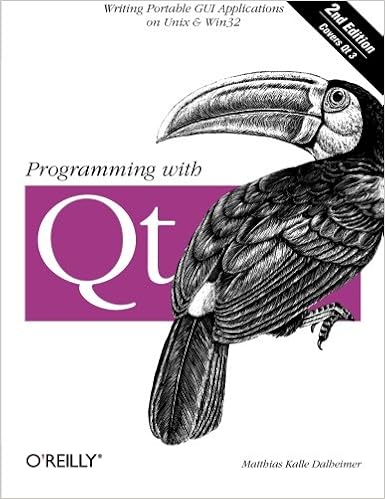
Download PDF Programming with Qt (2nd Edition)

Download PDF Programming with Qt (2nd Edition)

If you actually want to be smarter, reading can be among the whole lots ways to evoke and realize. Many individuals who such as analysis will certainly have much more understanding and experiences. Reading can be a means to acquire information from business economics, politics, scientific research, fiction, literature, faith, and also many others. As one of the part of book groups, Programming With Qt (2nd Edition) always ends up being the most wanted book. Lots of people are absolutely looking for this book. It means that several like to read this type of book.

Programming with Qt (2nd Edition)

Programming with Qt (2nd Edition)


Programming with Qt (2nd Edition)


Download PDF Programming with Qt (2nd Edition)

Amazing product is currently offered here. The book qualified Programming With Qt (2nd Edition) is offered in this site as one of the latest upgraded to offer. Yeah, this is among advised books that now many people try to find guide. You could become one of those who are really lucky today. You find this website that will provide you the best suggestion of this publication.

Definitely, to improve your life top quality, every book Programming With Qt (2nd Edition) will have their particular driving lesson. Nevertheless, having particular recognition will certainly make you really feel much more certain. When you really feel something happen to your life, in some cases, reviewing e-book Programming With Qt (2nd Edition) can aid you to make calm. Is that your real leisure activity? Occasionally indeed, yet sometimes will certainly be not certain. Your selection to read Programming With Qt (2nd Edition) as one of your reading publications, can be your proper book to check out now.

Well, still confused of how to get this publication Programming With Qt (2nd Edition) here without going outside? Merely connect your computer or device to the internet as well as start downloading Programming With Qt (2nd Edition) Where? This page will show you the web link page to download and install Programming With Qt (2nd Edition) You never ever worry, your favourite publication will be earlier all yours now. It will be a lot easier to enjoy reading Programming With Qt (2nd Edition) by online or getting the soft documents on your gadget. It will certainly regardless of that you are as well as exactly what you are. This e-book Programming With Qt (2nd Edition) is written for public and you are among them who can enjoy reading of this e-book Programming With Qt (2nd Edition)

The author is actually smart to choose the words to utilize in making this publication. The choices of words are very important to create a publication. It will certainly be proper to read by such particular societies. But among the breakthroughs of this publication is that this book is actually appropriate for every society. You may not be afraid to know nothing after reading this book. Programming With Qt (2nd Edition) can assist you to locate several things after analysis.

Programming with Qt (2nd Edition)

Amazon.com Review

For anyone programming Qt, Programming with Qt, Second Edition provides an excellent one-volume tutorial and reference to virtually all the features and APIs available in the powerful Qt C++ GUI cross-platform library. Whether you are just starting out with Qt, or want to catch up on new and advanced features, this title offers an invaluable resource for readers. The no-nonsense approach and right-on-target examples help distinguish this text. The book begins by making a case for cross-platform development. (Qt shows that Java is not the only game in town in this regard.) A later section on good GUI design and some hints for better portability help make this title a good way to learn GUI programming from the ground up.Short, clear examples show off the basics, starting with a "Hello World" application. Emphasis is on using the Qt APIs effectively rather than getting bogged down in C++ syntax. Since GUI programming is a strength, the author covers the built-in "widgets" available in Qt in excellent detail, including fancier controls like tables and new dial components. The Qt library is also a general-purpose application framework, and there's coverage here for file APIs, collections, and late-breaking support for XML processing.The basics are augmented here with short sections showing particular APIs at work. Most readers will likely find the material on Qt's SQL Module for database programming indispensable. A section on custom controls is also a standout and more advanced readers will learn how to using OpenGL calls in Qt as well as how to interoperate with Perl modules.The book closes with sections that will benefit the less experienced Qt developer, including how to use Visual C++ 6 to let you build Qt executables, and how to take advantage of Qt's Designer tool to simplify designing forms and components visually.Right up to date with the latest on Qt from top to bottom, this text really shines with its notably concise and authoritative style that readers will have come to expect from O'Reilly titles. For anyone tackling Qt development, the second edition of Programming Qt is sure to be a necessary addition to your programming bookshelf. --Richard Dragan

Read more

About the Author

Matthias Kalle Dalheimer is the President & CEO of Klaralvdalens Datakonsult AB, a Sweden-based consultancy specializing in platform-independent software solutions. He is also a founding member of the KDE project and the current president of the KDE foundation. Kalle has written numerous books for O'Reilly, both in English and in his native German, including "Running Linux" and "Programming with Qt" In his spare time, he enjoys cross-country skiing and reading history books. Kalle lives with his wife Tanja and his two sons Jan and Tim in the middle of the forest near Hagfors in the Swedish province of Varmland.

Read more

Product details

Paperback: 512 pages

Publisher: O'Reilly Media; 2nd edition (January 2002)

Language: English

ISBN-10: 9780596000646

ISBN-13: 978-0596000646

ASIN: 0596000642

Product Dimensions:

7 x 1.1 x 9.2 inches

Shipping Weight: 1.6 pounds (View shipping rates and policies)

Average Customer Review:

3.2 out of 5 stars

21 customer reviews

Amazon Best Sellers Rank:

#402,780 in Books (See Top 100 in Books)

Unless you are seeking a historical perspective back to rev 3 I would suggest you skip this one. As it was written for Qt3, circa 2002 it has very little that could be called current in today's world of 4.7 and beyond. At the time I wrote this 4.8 has been released, and Nokia (the current Qt owner) has chosen a different path for its own future. The Licensing model used then was different, and the concept of Microsoft dot.Net did not exist in the Windows world so cross-porting there was in fact simpler by today's environment. The book itself is well written, but time has passed it by.

Book starts out strong, and was helpful as an introduction for Qt. However, it seems to cut out about 350 pages in, putting subjects such as "Focus Handling" in its own 3 page chapter, rather than integrating it into an existing chapter. That said, the Portability chapter, which includes a list of Qt functions that are not portable, was a valuable addition.Keep in mind, the 2nd edition of Programming for Qt was written for Qt 3. At the time of this review, the latest version of Qt is version 4. This is a problem because Trolltech appears to reinvent the wheel for each major version. While the author had me salivating at the thought of a QStyleSheet, checking the API docs for Qt 4 QStyleSheet is now a deprecated class, and as far as I can tell there is no current equivalent.One aspect I wish the author had covered in more detail is the actual compiling and linking of applications that use Qt. I'm starting to get the impression that Trolltech's dirty little secret is that while their API is both clean and thorough, the signal/slot method is overly reliant on #defines, and the developer has to compile and link as many as twice the number of files to make it function. Trolltech includes a program 'qmake' almost as a bandaid which will generate Makefiles that will then automatically generate and compile the extra 'moc' files. The problem is that if you're porting an application to Qt, you're likely to have existing makefiles. Adding the additional layer of qmake and it's .pro files is both cumbersome and not actually necessary. While you can certainly figure out on your own how to avoid using qmake, it would have been helpful if the book described the functionality of the qmake-generated makefiles. This would help developers porting to Qt to include that functionality in their existing makefiles.

I found this book to be clearly written, and not difficult to follow and succinct, and not sufficient to answer enough of my programming questions to feel comfortable creating my own programs. You definitely need to study the Troll Tech-provided documentation to go very far beyond the book in programming, but the documentation reads like it was written as a reference, for people who understand but simply need a reminder. The book needs about two hundred more pages explaining examples and critical subjects like slot-signal interactions, layouts and many of the widgets more completely.This book makes a good overview, but needs more depth. At the time, it was about the only book available, so I cannot say that it was a mistake to get the book when I did. I hope that other books coming out on Qt have more depth and more complete explanations.

This book is old but I found it useful to understanding QT. If you are interested in designing and writing computer software I highly recommend Qt and KDE!

This book gives you a relatively quick and easy introduction to using Qt. You should know the fundamentals of C++ programming to benefit from the book. However, if you seriously want to get into using Qt are several much more up to date titles that also comes with a more modern and appetizing style. I bought this item because I have been using Qt for some time (Qt really rocks!) and went in to get all the books without critically reviewing before buying.

Great Book

Very well laid out. Easy to follow. Seems to follow QT 3 so the examples have to be converted to QT 4 if you are using the latest release.

No qt 5 stuff and it’s really different now versus 4

Programming with Qt (2nd Edition) PDF
Programming with Qt (2nd Edition) EPub
Programming with Qt (2nd Edition) Doc
Programming with Qt (2nd Edition) iBooks
Programming with Qt (2nd Edition) rtf
Programming with Qt (2nd Edition) Mobipocket
Programming with Qt (2nd Edition) Kindle

Programming with Qt (2nd Edition) PDF

Programming with Qt (2nd Edition) PDF

Programming with Qt (2nd Edition) PDF